No one knew the origin of the megalithic complex, but some suggested through the legends and tradition. Some like Geoffrey of Monmouth (about 1100-1154 AD.) In the Middle Ages, their stories told in the popular belief that the whole was a petrified giant circle, hence he was known as the "Dance of the Giants" . But the same writer of the twelfth century has sent another legend which suggested that the stones were brought there by the magician Merlin, from Ireland, with the help of some "artifacts".
In the seventeenth century John Aubrey (1626-1697), writer and scholar who studied ancient megalithic monuments in England, said that Stonehenge was a temple built by the Druids. Later that century, William Stukeley supported him. . Druids However, those ancient Celtic priests, had nothing to do with Stonehenge, the megalithic complex since existed two millennia before. representing Stonehenge as a temple ritual where druids propitiated the gods of nature through human sacrifices. Finally in 1985 the British government decided to take over the protection and conservation of Stonehenge and among his first acts was to prohibit fraudulent celebrating this ritual.
The mystery and magic of Stonehenge continued speaking people. Some attributed healing powers, including the power to make any couple fertile to sleep on their land. These and other assumptions made and puritanical Roman churches consider these sites as pagan temples, places where witches performing rituals for Satan. Some alien groups alleged witches and wizards came to celebrate sabbats nearby.
At the beginning of the twentieth century a researcher was able to determine with a fair degree of certainty the age of Stonehenge. In 1901 the astronomer Sir Norman Lockyer confirmed an open secret that circulated about Stonehenge: a person at the bottom of the "altar stone", looking toward the "heel stone" could be observed with great accuracy the spot where the sun rises during the summer solstice, June 21. Sir Norman Lockyer had made one of the most detailed studies of the precession of the equinoxes, a phenomenon whereby in the course of the centuries the sun has an offset relative to the constellations. Norman Lockyer calculations gave the amazing date of 1800 BC. Subsequent carbon-14 datings carried the beginnings of Stonehenge to 2800 BC. This many theories as to its origin Assyrian, or Greek Mycenaean were discarded. Now suppose that some Neolithic civilization must have precéltico source who erected this monumental set.
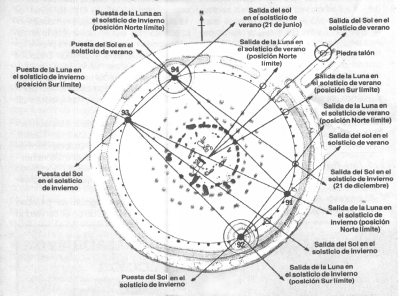
Schematic of Stonehenge and astronomical alignments.
Today we know more than the function of Stonehenge. Like the "altar stone" and "heel stone" line to show the point of sunrise at the summer solstice, just as the two mounds and standing stones located along the circular moat are aligned to point towards the rising and setting of the sun during the summer and winter solstices.They also mark the exits and moonset during the winter solstice. In other words Stonehenge was a temple dedicated to the movements of the sun and moon, stars that govern the cycle of the seasons. A calendar that observed wisely allowed predicting the arrival of seasons in anticipation of the activities of farmers and cattle domestication that took the time to build it, and later also became a sacred site.
In the center is the "altar stone" of 4.8 meters long, lying on the ground. This is a stone with a high aluminum content, which gives it a very special shine to receive sunlight.
How was it built?
Stonehenge represents a colossal effort of planning and preparation. Definitely not made of one day, but was taken various forms throughout the life of forty generations. Currently, as Richard Atkinson archaeologists believe that Stonehenge was built three main phases.
The first phase took place around the year 2800 BC. That's when he made the rampart and ditch circular. They put stones and mounds called "the four seasons" and the "Heel Stone" in the driveway. The main indicators of the sun and moon were made. 56 holes were also known as Aubrey circles.
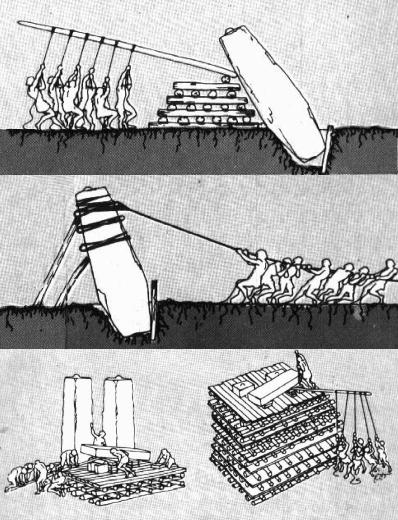
Sequence trilithons procedure to erect Stonehenge.
The second phase took place around the year 2100 BC. 80 blocks were erected blue sandstone in a semicircle or horseshoe. These stones come from the mountains of Precelly, located 320 km to the southwest of Wales. Chances are that the transported on rafts along the Welsh coast, entering Bristol along the River Avon. Then would be carried by river and land until, on rollers, to Stonehenge Avenue where forming two circles would be installed. One hundred years later, the blue sandstone blocks were rearranged to be replaced by siliceous rocks we see today (a circle and a semicircle). These stones were brought from the hills of Marlborough, about 30 miles north. Some of the latter arrived stones weigh up to 26 tons, transport was made of rollers, ropes and levers. Once on site of its erection, was digging a trench and, little by little, the block was built with a series of levers, beams and ropes until the angle by its own weight and fell into the pit. A base strings are put upright. Finally gradually built a platform to go up and put the lintel of seven tons on top of two vertical blocks. The stones were carved in a clever play on pins and cavities for columns and lintel embonaran perfectly. Previous semicircle materials to be used a second horseshoe inside the main circle. Are dug in the external part a series of holes set to erect a double circle bluestones (Aubrey circles), but this construction is never performed.


The third phase takes place around 1500 BC. when the blue stones were again withdrawn to settle in their current positions within the circle, while stood in front of the call trilithons Altar stone, which was hauled from South Wales.
Finally around 1100 BC. Stonehenge was abandoned.
New mysteries.
Stonehenge is the greatest work of an ancient society interested in stargazing and their association to their beliefs. But not the only megalithic construction. Throughout Ireland, England, Spain, Portugal and France there are several sets of stone astronomical functions and / or rituals. These sets have sometimes been subsequently inherited by other civilizations for their own or inherited rituals such were the case of the Celts, the Druids, the Gauls and even Christians, since many churches were built over ancient dolmens and menhirs. This, far from revealing the tendency of religion to paganism, is confirmation of how our relationship with nature ("relative = religare = religion") is not lost, and that the legacy of sacred sites has presented from the Neolithic period to the current is further evidence of religious syncretism that holds human beings in their concern about the universe and its history.
Equally disturbing is the existence of megalithic in other remote areas of western Europe. In April 1998 he announced the existence of an ancient astronomical observatory at Stonehenge style Nabta, Egypt. In the north east coast of the United States several dolmens found in states such as New England, Massachusetts, Pennsylvania, Virginia and Vermont. Would these products also sets the pre-Celtic civilization? It is a question that still bothers archaeologists and historians. The thought of a European civilization before the Vikings and Columbus was able to cross the Atlantic Ocean cause much controversy, although certain insinuate Irish legends. At the moment there is not much material to get an answer. What's more a collection of megalithic stones with certain airs and until recently have been placed archaeoastronomical in an area well away from the sets of the east coast of the United States. A sort of "Stonehenge" has been located for our wonder and enjoyment in Mexico. It is located in a place known as "The Eagles", near Cuautla de la Paz, in the state of Jalisco. This site was made known at the time by team reporters "Unknown Mexico" and as in "Stonehenge" in the summer solstice a beam of light finds its way between two monoliths and illuminates with a "pin light" a stone located 15 meters away. It seems that this megalithic played both ceremonial and astronomical functions unfortunately takes a lot of research and communication on this site. For this reason it is best not expand much on this "unknown discovery." Who knows, maybe soon there is an opportunity to spend a full monograph.
